Japanese dragon tattoos are known for their flowing compositions, intricate details, and strong visual presence. Inspired by Japanese mythology and traditional tattoo art, dragons are commonly associated with strength, wisdom, protection, and powerful natural forces. Unlike the winged dragons common in Western imagery, Japanese dragons are typically depicted with long, serpentine bodies that work beautifully across the arms, back, chest, and legs. Whether rendered in traditional colors or dramatic black and grey, these tattoos make impressive statement pieces.
How to Choose the Right Japanese Dragon Tattoo
Start by deciding whether you want a traditional Japanese-inspired composition or a more contemporary interpretation. Consider how the dragon’s long body will flow with the natural contours of your chosen placement. Large areas such as the back, chest, thigh, and arm provide enough space for scales, claws, facial features, and surrounding elements to remain clear. Dragons can be paired with waves, clouds, wind bars, flowers, or other imagery to create a complete composition. If historical or cultural authenticity matters to you, work with an artist knowledgeable about Japanese tattoo traditions and symbolism.
Japanese Dragon Tattoo Ideas
Image 1
This forearm tattoo presents a dramatic Japanese-inspired dragon winding vertically along the arm. The dragon’s elongated, scaled body curves through the composition, leading toward a highly detailed head with sharp horns, flowing whiskers, fierce eyes, and an open mouth.

Dense black and grey shading creates strong depth, while muted red accents appear throughout the surrounding flowers and ornamental details. Near the upper portion, architectural and landscape imagery resembling a Japanese torii gate and trees adds narrative scenery. Large blossoms frame the dragon near the wrist and body. The dark background gives the entire tattoo a powerful, atmospheric, almost cinematic appearance.
Image 2
This black-and-grey Japanese dragon tattoo uses the length of the forearm to create a tightly packed, vertically flowing composition. The dragon’s large head dominates the lower section, featuring long horns, an aggressive expression, pronounced brows, sharp teeth, and sweeping facial details. Above it, the scaled body coils upward through stylized waves and curved ornamental forms.
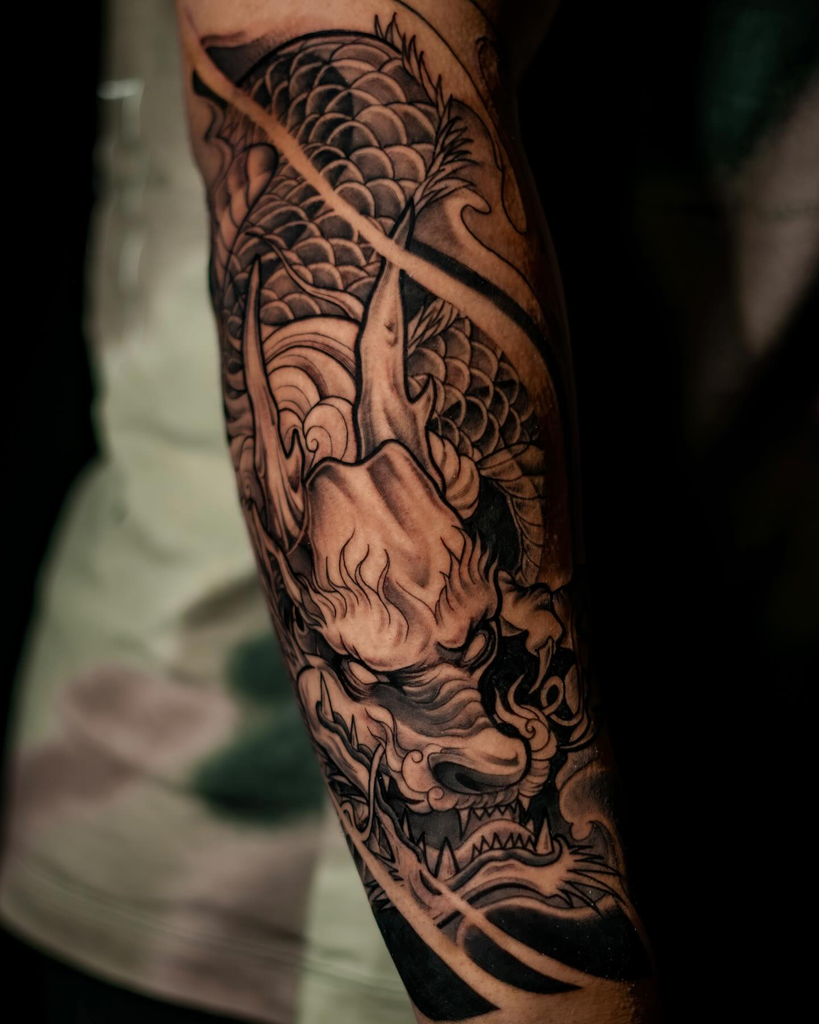
Repeated scale patterns are carefully shaded to create dimension, while areas of solid black provide strong contrast against untouched skin. Broad sweeping lines cross portions of the design, reinforcing movement. The combination of traditional Japanese motifs, bold outlines, smooth shading, and dramatic negative space gives the tattoo considerable visual intensity.
Image 3
This elaborate forearm piece combines a Japanese-inspired dragon with a brightly colored koi fish, producing a dynamic narrative composition. The dragon occupies the upper half, with a powerful head, flowing horns, whiskers, claws, and a serpentine body surrounded by dark atmospheric shading.
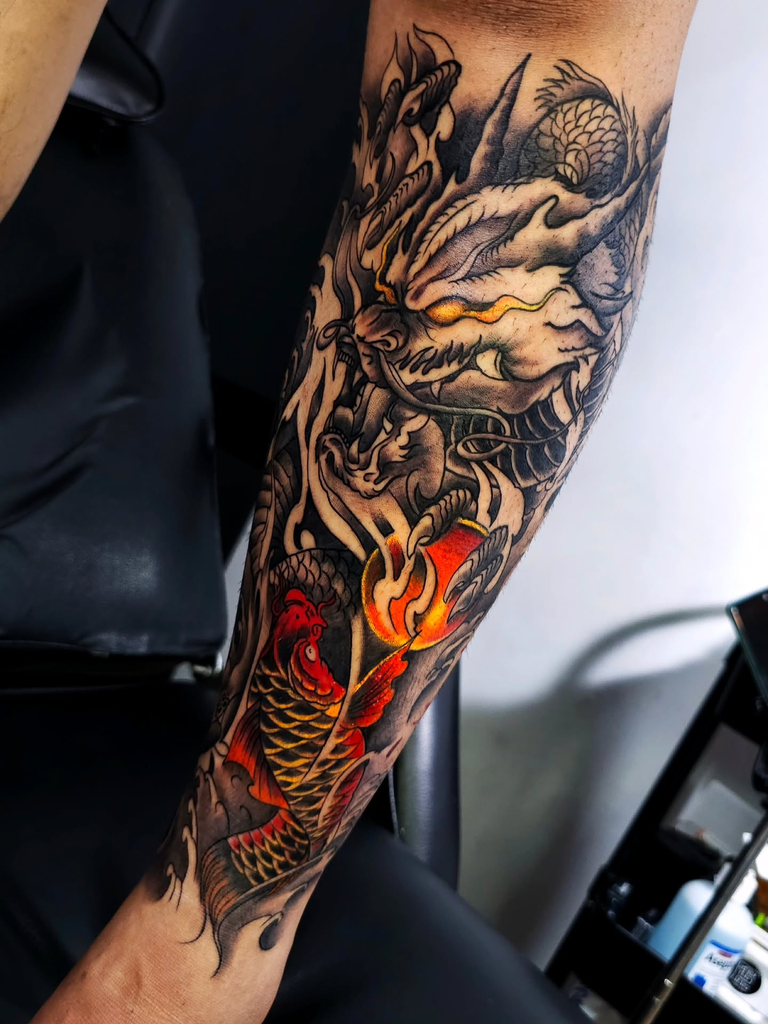
Its glowing orange-yellow eyes immediately draw attention and introduce color into the otherwise muted upper section. Below, a vivid koi fish appears in red, orange, black, and gold tones, swimming through stylized water and flame-like forms. Heavy black shading connects both subjects. The contrasting dragon and koi create a striking balance between detailed monochrome work and concentrated areas of saturated color.
Image 4
This upper-arm tattoo depicts a long Japanese-style dragon twisting through a field of stylized clouds. The composition follows the natural vertical shape of the arm, with the dragon’s head positioned near the shoulder and its serpentine body forming several large coils before narrowing into a sweeping tail. Fine black outlines define individual scales, claws, horns, facial hair, and flowing mane details, while soft grey shading adds depth without overwhelming the skin.
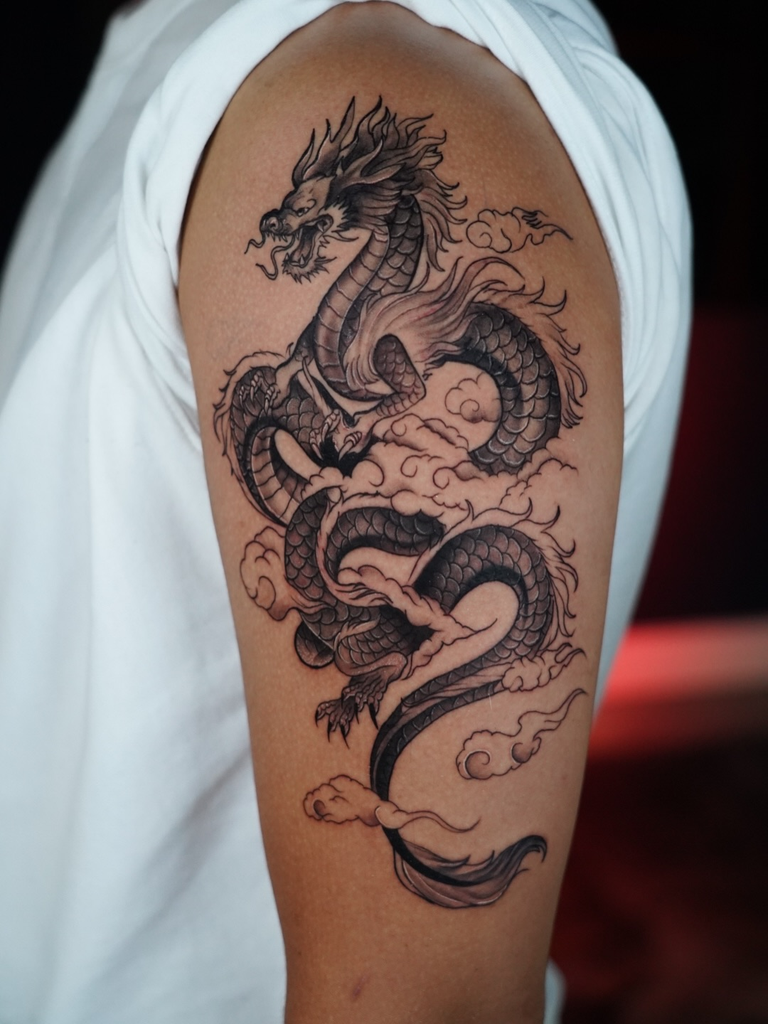
Open areas between the coils keep the design breathable and readable. Rounded cloud motifs weave around and behind the dragon, reinforcing the traditional East Asian atmosphere and creating a strong impression of airborne movement.
Image 5
This close-up black-and-grey tattoo emphasizes the expressive face and upper body of a Japanese-inspired dragon. The dragon appears fierce and confrontational, with large rounded eyes, an open mouth, sharp teeth, a curling tongue, prominent whiskers, and flame-like hair surrounding the head. Heavy outlines establish the major forms, while stippled and smooth grey shading gives texture to the face and surrounding elements.

The segmented underside of the dragon’s body curves prominently through the lower portion, contrasting with the smaller overlapping scales along its side. Stylized clouds frame the creature, creating movement while preserving areas of exposed skin that prevent the composition from becoming visually overcrowded.
Image 6
This full-arm Japanese-style tattoo creates an immersive sleeve centered on a large dragon surrounded by waves and red blossoms. The dragon’s head dominates the shoulder, featuring intense yellow eyes, an open mouth, pointed teeth, long whiskers, and expressive facial contours. Its scaled body travels downward along the arm, partially concealed by turbulent water and dark background forms.
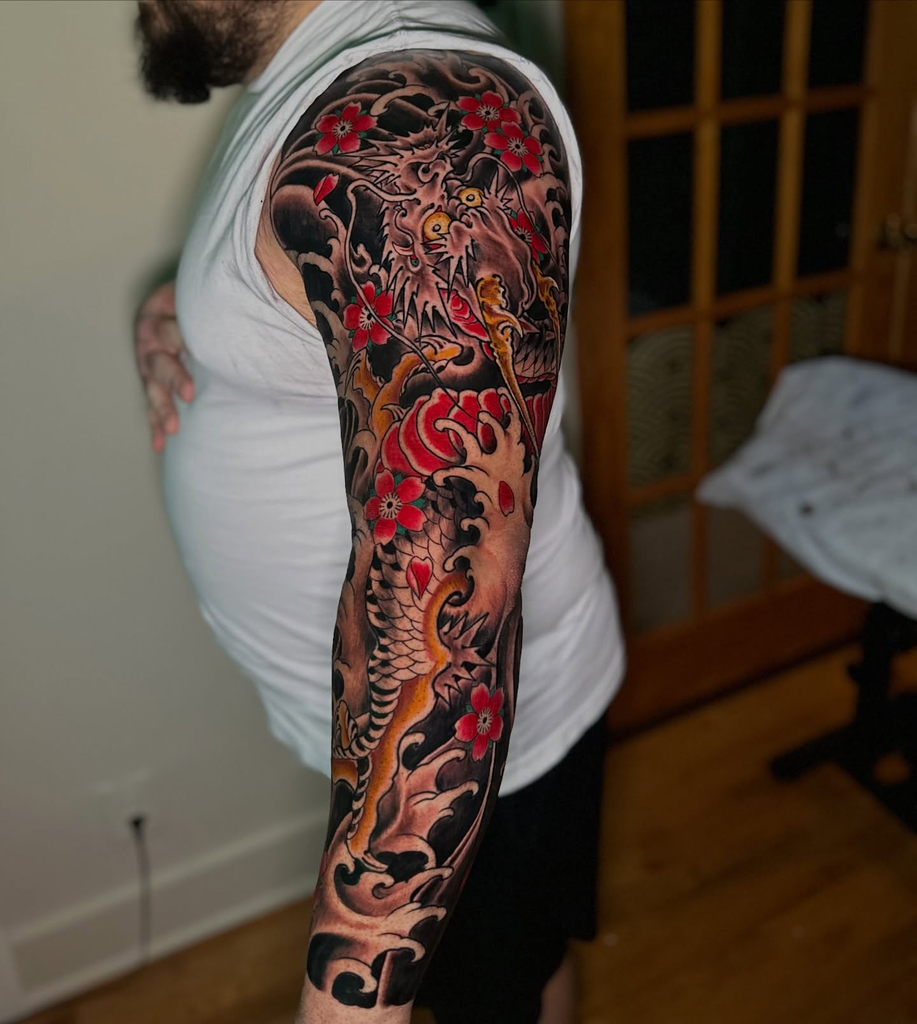
Bright red flowers and scattered petals punctuate the predominantly black, brown, and muted orange palette, giving the sleeve vivid focal points. Bold wave shapes wrap naturally around the arm and unify the composition. The extensive coverage, dense shading, and traditional imagery produce a powerful, highly decorative Japanese-inspired aesthetic.
Image 7
This forearm tattoo combines a Japanese dragon with a samurai figure and a large floral element, creating a detailed narrative scene in black and grey. The dragon occupies the upper section, with its fierce head, horns, mane, and scaled body emerging behind the armored warrior. The samurai is positioned centrally, wearing layered armor and holding a sword, giving the composition a strong martial character.
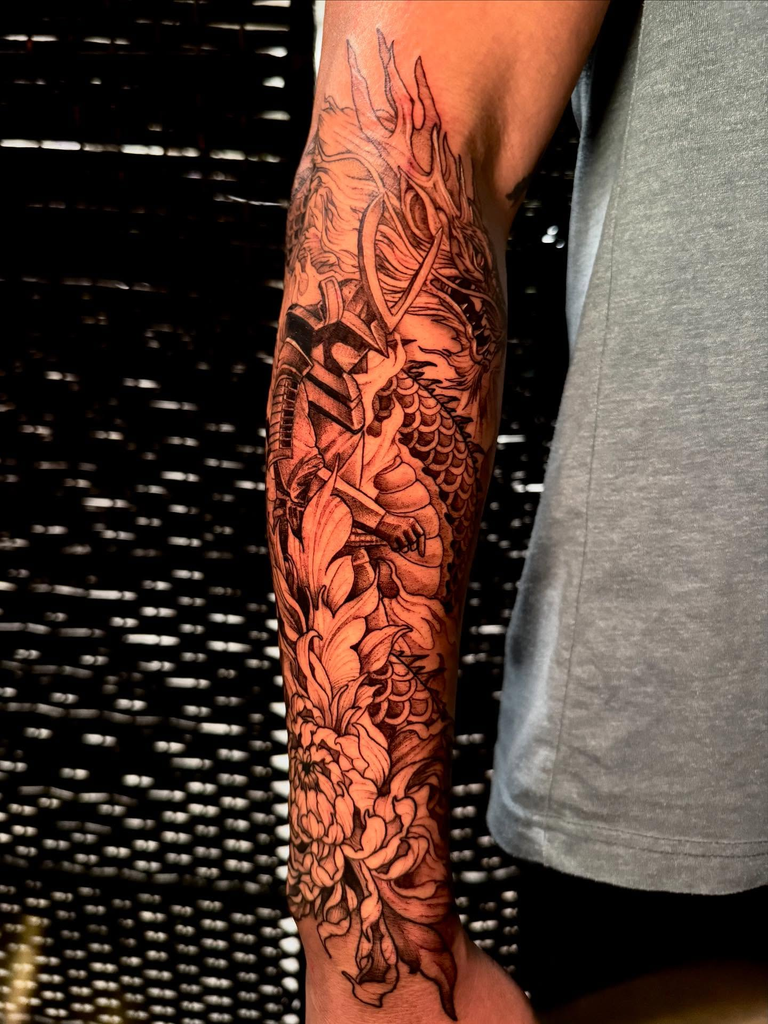
Below, a large chrysanthemum-like flower fills the wrist area with overlapping petals and soft shading. Fine linework defines scales, armor plates, facial details, and foliage. The vertical arrangement allows the separate subjects to connect naturally while maintaining clear individual visual identities.
Image 8
This forearm tattoo combines a large Japanese-inspired dragon with scenic imagery associated with Japan. The upper portion features a coiling black-and-grey dragon surrounded by blossoms, with detailed scales, horns, flowing facial hair, and an aggressive open mouth. Beneath the dragon, the composition transitions into a landscape dominated by a large pale sun with soft red shading.
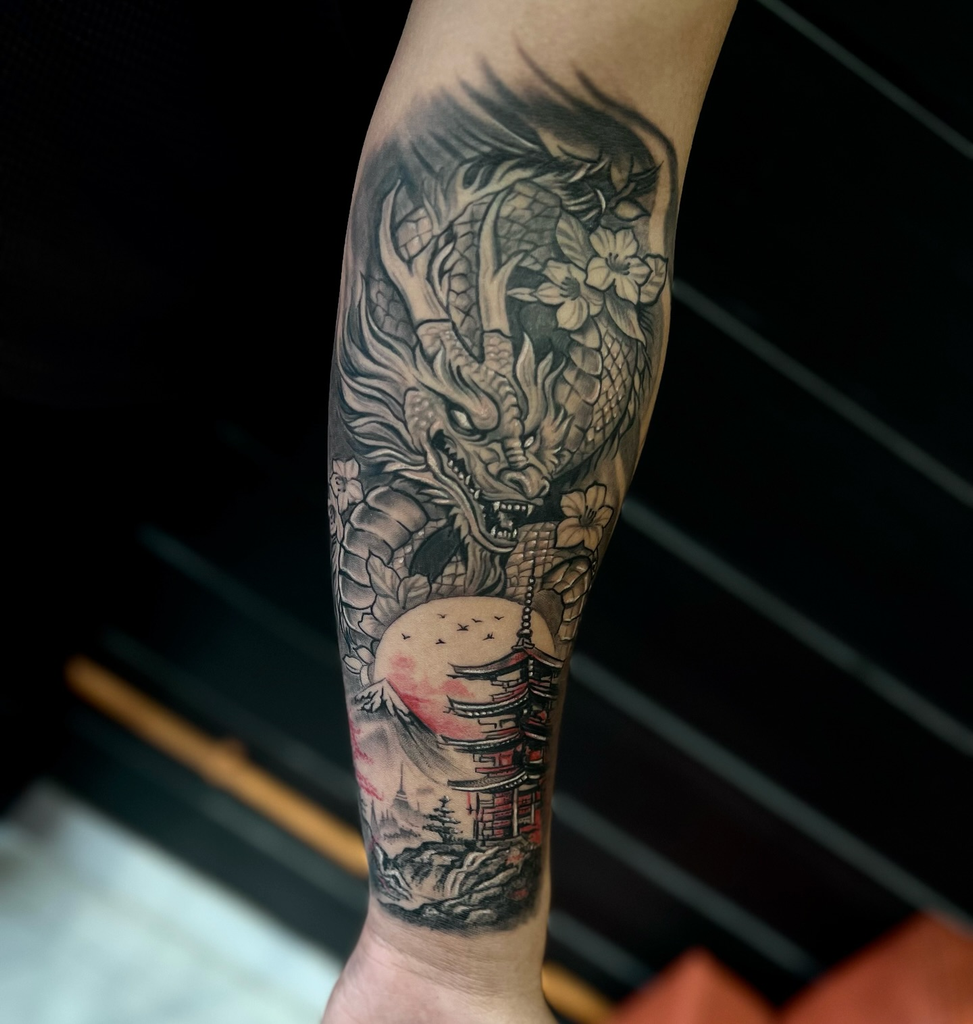
A multi-tiered pagoda stands prominently in front of the sun, while mountains, trees, birds, and textured terrain complete the lower scene. Selective red accents appear on the architecture and landscape. The mixture of mythical creature and tranquil scenery creates an atmospheric composition balancing dramatic fantasy with delicate illustrative detail.
Image 9
This bold Japanese-style dragon tattoo covers much of the lower leg with a highly saturated red, black, orange, and grey palette. The dragon’s fierce face forms the central focal point, featuring glowing orange eyes, pronounced brows, sharp teeth, horns, and sweeping whiskers. Its long scaled body coils repeatedly around the leg, creating a strong sense of circular movement.

Dense black background sections dramatically separate the lighter scales and red ornamental forms, while fiery red shapes weave between the dragon’s body. Thick outlines and solid color fields give the piece a traditional, graphic quality. The high contrast makes the dragon immediately readable even across the curved leg.
Image 10
This full-sleeve tattoo presents a vibrant Japanese-style dragon surrounded by flowers, flames, scales, and sweeping ornamental forms. The dragon’s expressive head dominates the upper arm, featuring wide red eyes, an open mouth, prominent horns, and fiery orange accents around its mane. Its scaled body coils down the arm in black, grey, and purple tones, creating continuous movement from shoulder to wrist.
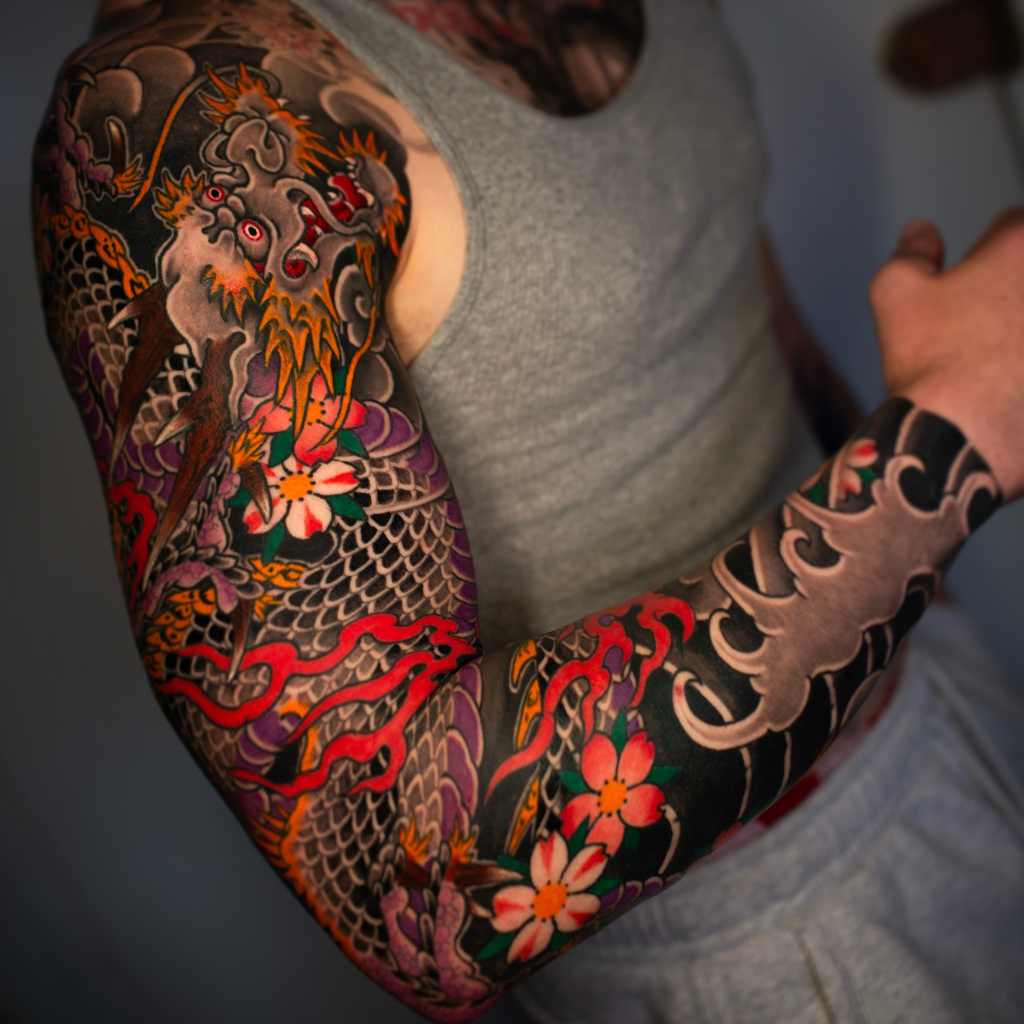
Bright red flames and colorful blossoms introduce strong contrast against the dense black background. Green leaves and orange details add further variation. The extensive saturation, bold outlines, and interconnected imagery give the sleeve a powerful traditional Japanese tattoo character.
Image 11
This black-and-grey sleeve uses a large Japanese-inspired dragon as the central subject, extending from the shoulder down toward the wrist. The dragon’s fierce face occupies the upper arm, with expressive eyes, an open mouth, sharp teeth, whiskers, and layered facial features. Its scaled body continues downward through stylized waves, flowers, and swirling background elements.
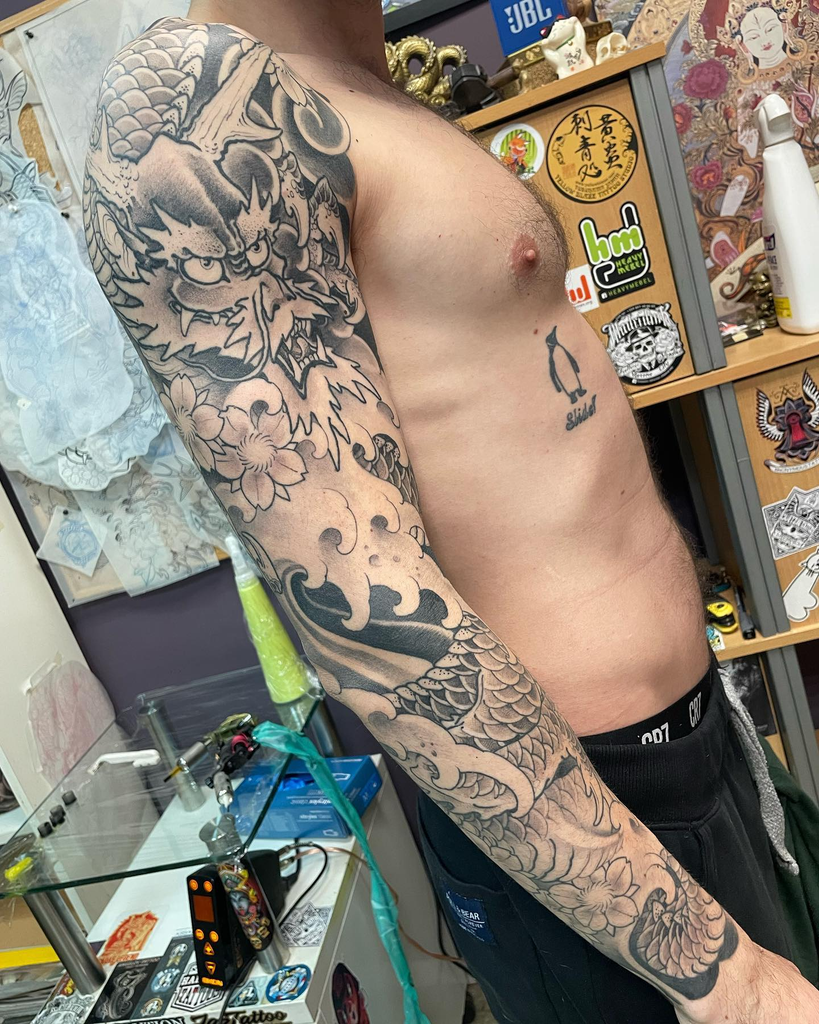
Large areas of negative skin remain visible between the darker sections, allowing the intricate linework to remain clear. Repeated scale patterns create rhythm throughout the sleeve, while soft shading adds dimensionality. The combination of dragon, water, and floral imagery produces a cohesive composition that follows the arm naturally.
Image 12
This forearm tattoo combines a dramatic dragon portrait with a Japanese landscape, blending fantasy imagery and scenic symbolism into one vertical composition. The dragon’s enormous head fills the upper portion, rendered with detailed scales, elongated horns, sharp teeth, flowing whiskers, and an intense red eye. Dark blue-grey background shading emphasizes its face, while selective red highlights create a supernatural atmosphere.

Beneath the dragon stands a vivid red torii gate surrounded by dark rocks, water, distant trees, and reddish foliage. The transition from creature to landscape is especially effective, creating depth and suggesting the dragon emerging protectively above a mysterious Japanese-inspired sacred setting.
Image 13
This full-arm Japanese-style tattoo features a large serpentine dragon wrapping continuously from the shoulder toward the forearm. The design relies heavily on black, grey, and natural skin tones, giving it a restrained traditional appearance. The dragon’s head sits prominently on the upper arm, surrounded by stylized clouds and floral motifs, while its long scaled body twists downward in broad overlapping curves.
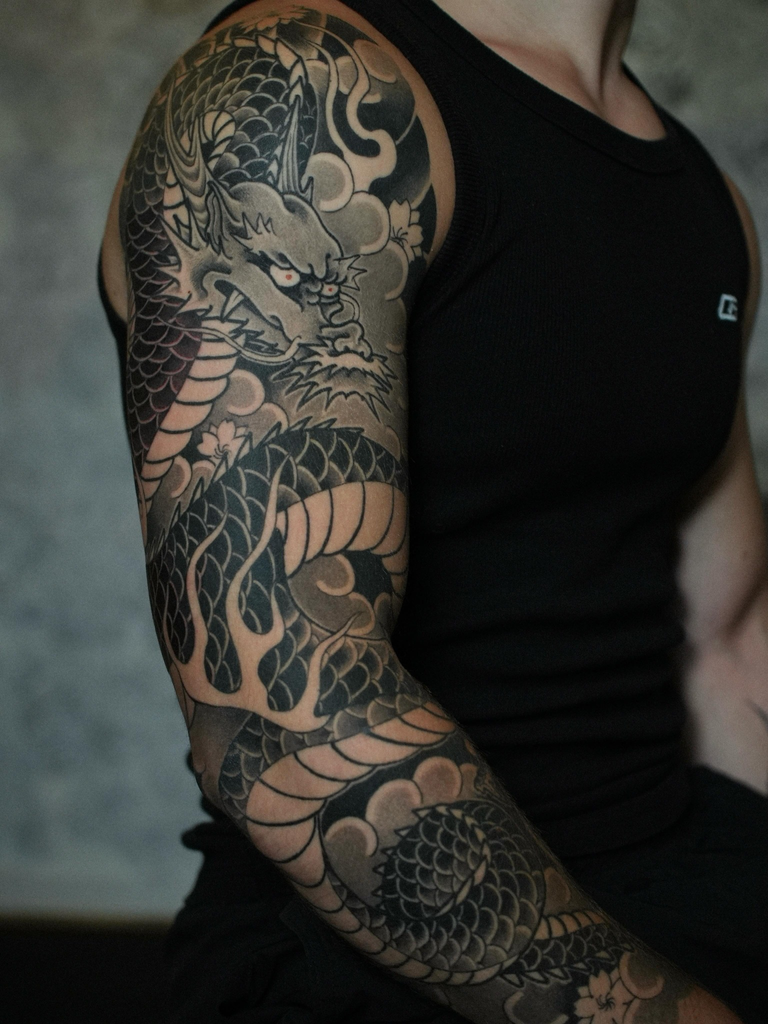
Large segmented belly plates contrast against the smaller dark scales covering its back. Black background areas create strong separation between individual forms. Small red accents around the dragon’s eyes provide a subtle focal point, adding intensity without disrupting the predominantly monochromatic composition.
Image 14
This forearm tattoo presents a finely detailed dragon coiling around a vertically positioned sword. The dragon’s serpentine body forms several compact loops, creating a balanced composition that fits naturally within the narrow shape of the forearm. Fine black linework defines hundreds of small scales, segmented belly plates, claws, horns, whiskers, and flowing mane details.

The sword passes through the center of the composition, providing a strong structural axis while the dragon wraps dynamically around it. Soft black-and-grey shading adds volume without sacrificing detail. Flame-like ornamental lines surround the creature, reinforcing movement and giving this intricate design an elegant, controlled, illustrative appearance.
Image 15
This smaller dragon tattoo uses fine black linework to create a compact yet highly detailed design on the lower leg. The dragon forms a flowing S-shaped silhouette, with its head positioned at the top and its long body curving downward into a narrow tail. Individual scales, segmented belly plates, small claws, horns, facial hair, and a flame-like mane are carefully outlined despite the tattoo’s relatively modest size.
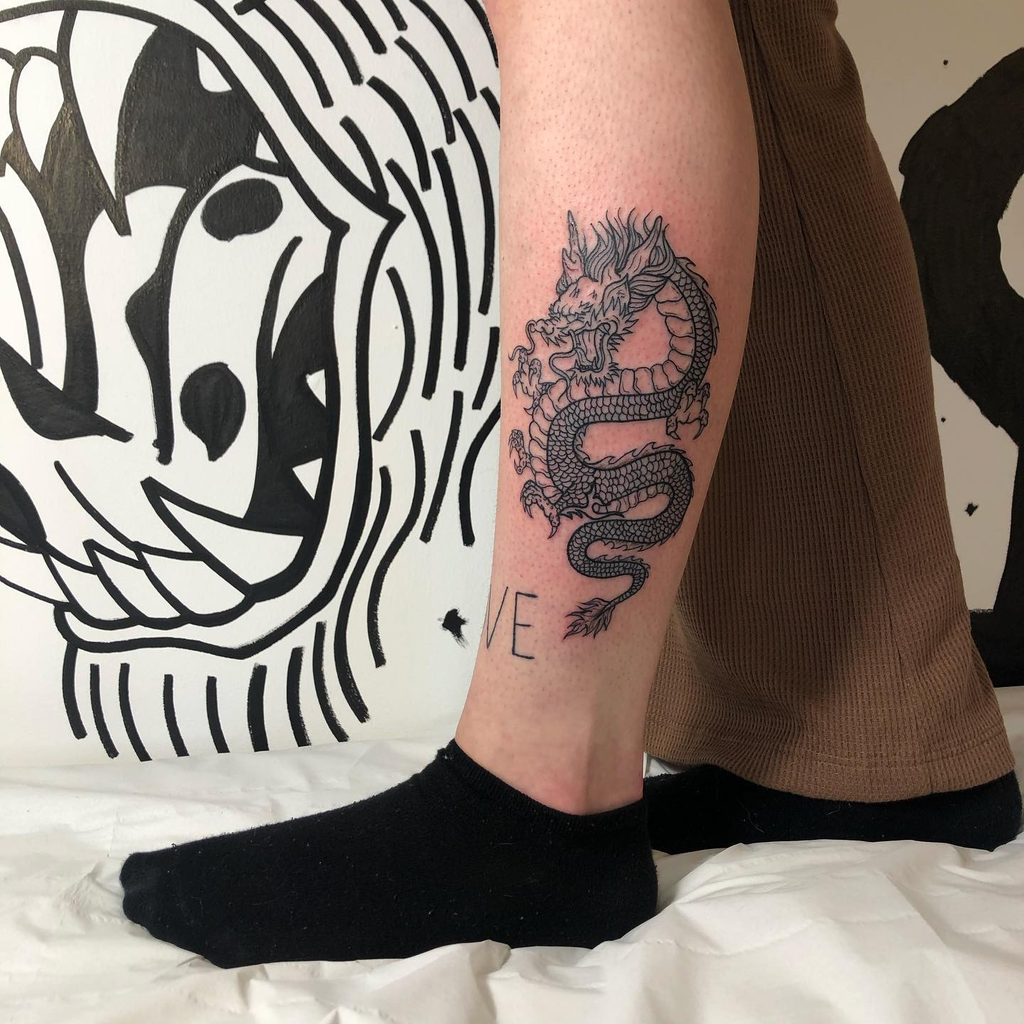
Minimal shading keeps the design light and highly readable, allowing the natural skin tone to provide most of the negative space. The restrained approach gives the dragon an elegant illustrative quality while preserving the movement associated with traditional serpentine dragon imagery.
Image 16
This black-and-grey forearm tattoo creates an intense composition by pairing a Japanese-inspired dragon with a fierce demonic mask. The dragon occupies the upper section, its scaled body arching around a detailed head with sharp teeth, flowing whiskers, horns, and an open mouth. Below it, the large mask becomes the second focal point, featuring exaggerated brows, glaring eyes, pointed ears, pronounced teeth, and a menacing expression.
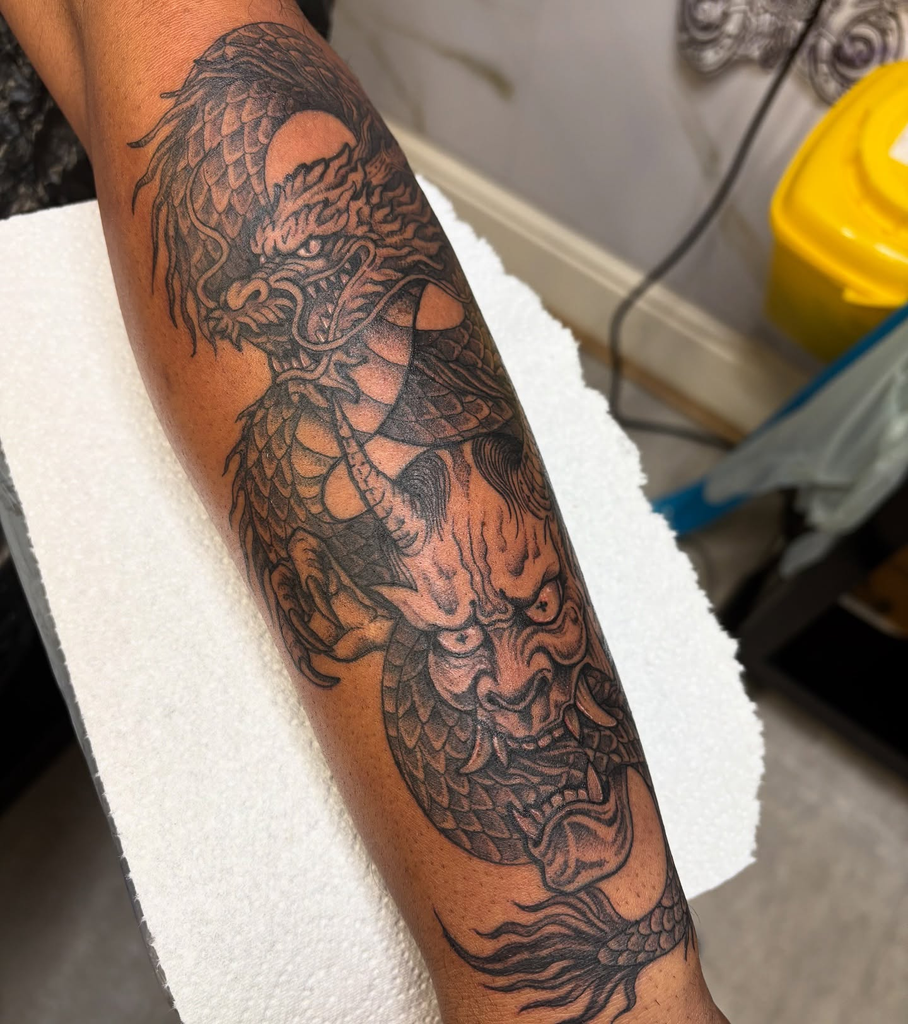
The dragon’s body curves around and behind the mask, visually connecting both subjects. Fine stippling and layered grey shading establish texture across scales, skin, and hair. The monochromatic treatment gives the overall piece a dark, dramatic atmosphere.
Image 17
This forearm tattoo focuses closely on a highly expressive Japanese-inspired dragon head rendered primarily in black and grey. Large sweeping horns and ornamental flame-like forms frame the face, creating a broad silhouette across the upper forearm. The dragon’s narrowed eyes, wrinkled brow, flared nose, sharp teeth, curling whiskers, and open mouth produce an aggressive expression.
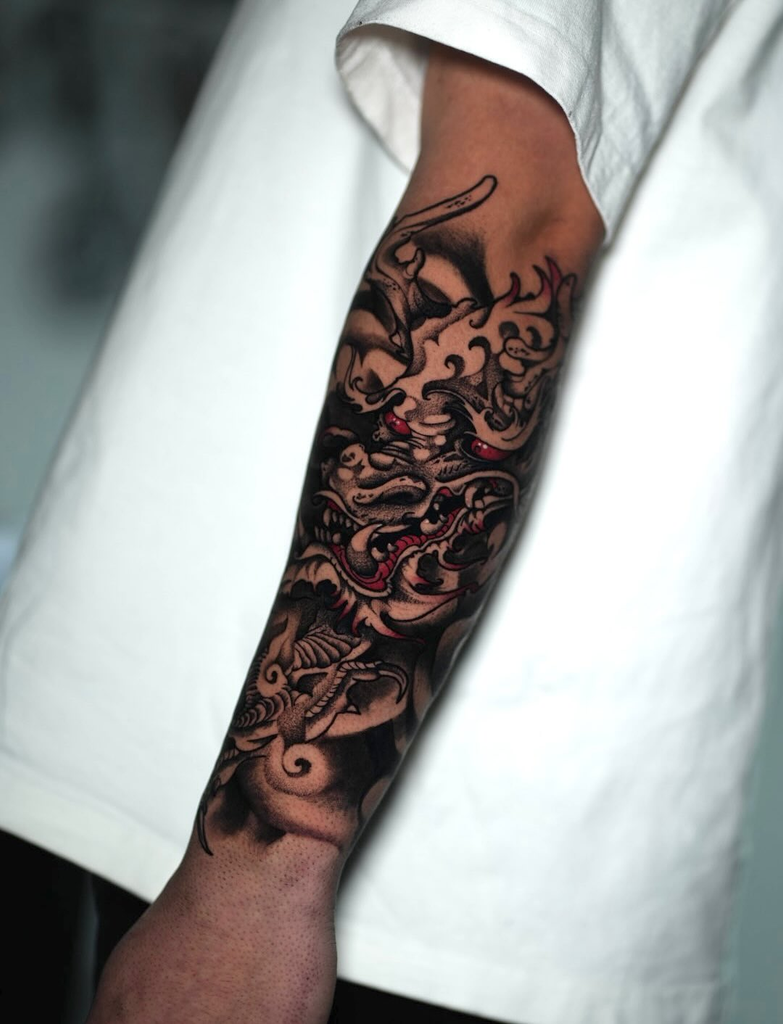
Small red accents appear around the eyes, mouth, and selected interior details, standing out dramatically against the surrounding dark shading. Dense black background sections create depth and make the lighter facial features appear more prominent. The design achieves considerable impact through strong contrast, controlled shading, and concentrated facial detail.
Tattoo Aftercare Tips
Japanese dragon tattoos are often large and can feature extensive shading, color, and intricate linework:
- Wash the tattoo gently with mild, fragrance-free soap.
- Apply moisturizer according to your tattoo artist’s instructions.
- Avoid scratching or picking at peeling skin.
- Wear loose clothing that minimizes friction against the tattoo.
- Avoid swimming and prolonged soaking until the tattoo has healed.
- Protect the tattoo from direct sunlight during healing.
- Once healed, use sunscreen regularly to help reduce fading.
Proper aftercare helps preserve detailed scales, strong outlines, smooth shading, and vibrant colors.
Conclusion
Japanese dragon tattoos combine dramatic visual impact with centuries of artistic and mythological inspiration. Their long, flowing forms make them particularly well suited to sleeves, backs, chests, and other large placements where the artwork can follow the body’s natural movement. Whether surrounded by waves and clouds or presented as the central focus of the tattoo, a carefully designed Japanese dragon can become a powerful expression of strength, wisdom, protection, and appreciation for Japanese tattoo art.
Frequently Asked Questions (FAQ)
Q1: What does a Japanese dragon tattoo symbolize?
Meanings vary by design and context, but Japanese dragons are commonly associated with strength, wisdom, protection, and natural forces such as water.
Q2: Where do Japanese dragon tattoos look best?
Popular placements include the back, chest, upper arm, full or half sleeve, thigh, calf, and side of the body.
Q3: What can be combined with a Japanese dragon tattoo?
Popular accompanying elements include waves, clouds, wind bars, peonies, chrysanthemums, cherry blossoms, and other imagery used in Japanese-inspired tattoo compositions.
Q4: Can Japanese dragon tattoos be black and grey?
Yes. Although traditional-inspired pieces can feature strong colors, black-and-grey designs can emphasize the dragon’s scales, movement, and dramatic shading.
Q5: Are Japanese dragon tattoos usually large?
Many are relatively large because the dragon’s elongated body and intricate details benefit from additional space, although simplified designs can be adapted to smaller placements.
