Cybersigilism tattoos combine futuristic aesthetics with sharp, abstract linework to create designs that feel digital, mysterious, and unconventional. Often featuring symmetrical shapes, spiked curves, fragmented patterns, and techno-inspired details, the style draws visual influence from sigils, cyber aesthetics, and tribal-like forms. From small symmetrical symbols to large compositions that follow the body’s contours, cybersigilism tattoos are ideal for those drawn to experimental and highly distinctive body art.
How to Choose the Right Cybersigilism Tattoo
Start by deciding whether you want a compact symbol or a larger design that flows across the body. Symmetrical cybersigilism can create a structured, balanced appearance, while asymmetrical patterns feel more organic and experimental. Black ink is especially popular because it emphasizes the style’s sharp lines and dramatic shapes. Placement matters as well—spine, sternum, lower back, shoulders, forearms, hands, thighs, and calves can complement the elongated forms commonly found in cybersigilism. For a more personal result, work with an artist who can develop an original composition rather than copying an existing design.
Cybersigilism Tattoo Designs
Image 1
This cybersigilism tattoo spreads across the forearm with an aggressive, fragmented composition built from heavy black forms and delicate skeletal outlines. The central structure resembles an abstract organic crest, combining hooked blades, thorn-like projections, curved cavities, and elongated spikes. Dense black shading gives the main section substantial visual weight, while surrounding fine-line shapes create a lighter, almost unfinished extension of the same structure.
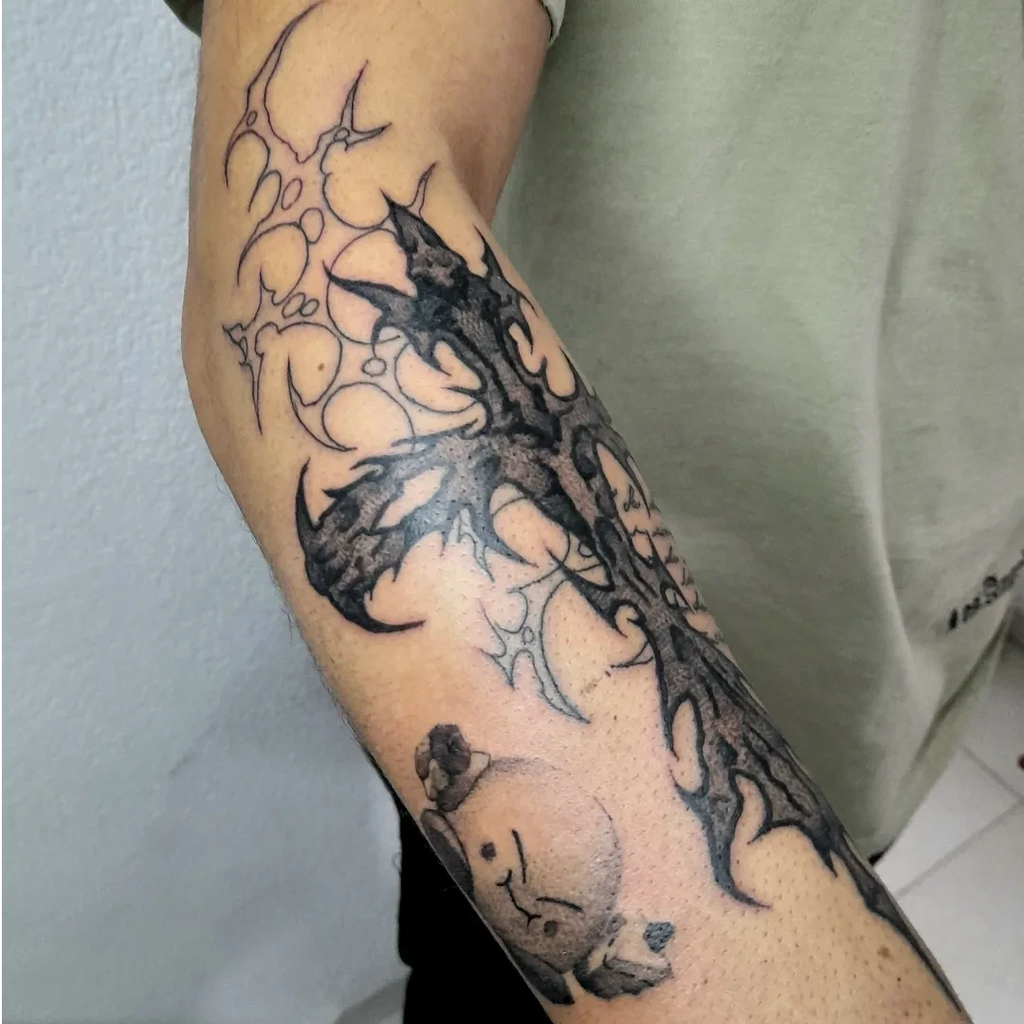
Irregular openings allow exposed skin to function as negative space throughout the design. The mixture of sharp geometry and biological curves produces a distinctly biomechanical quality, while the asymmetrical arrangement makes the tattoo appear to be evolving organically along the arm.
Image 2
This leg tattoo takes a highly minimalist approach to cybersigilism, using scattered black fractures that resemble cracks, electrical discharges, or branching veins. Rather than forming one solid emblem, the composition is divided into several irregular segments running vertically down the shin. Each section begins with thicker pools of black ink before narrowing into extremely fine, pointed extensions. Small isolated dots punctuate the open areas and reinforce the fragmented aesthetic.
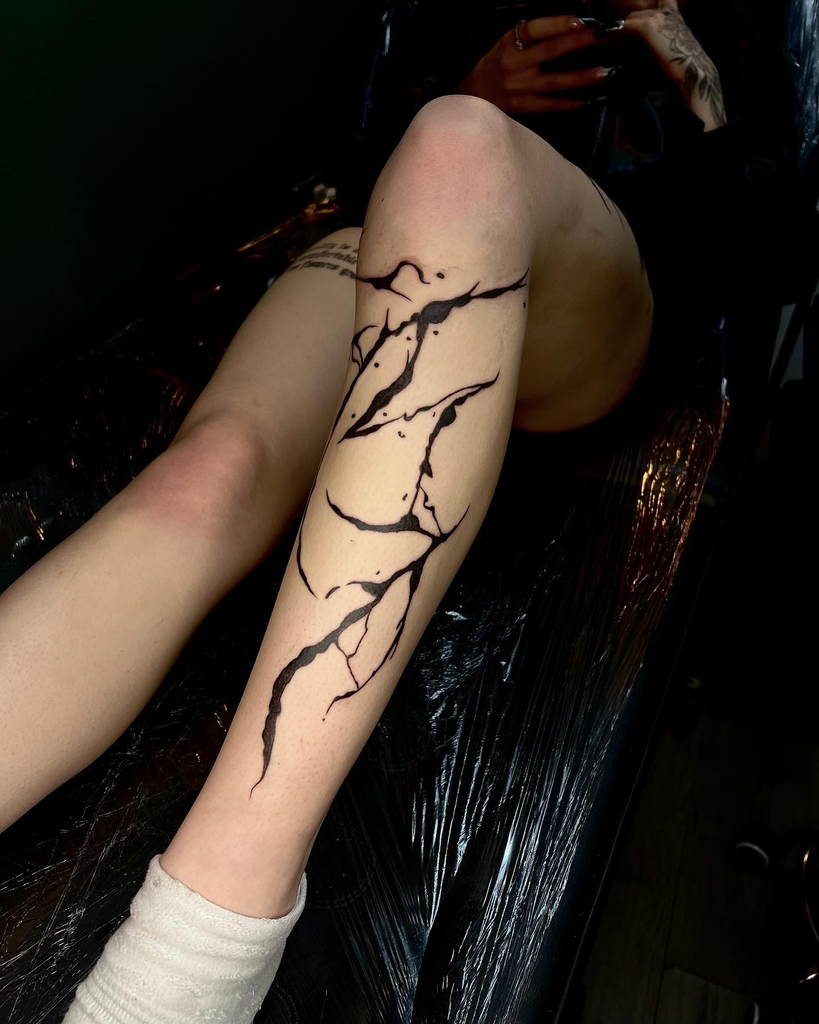
The extensive negative space is especially important, preventing the design from becoming visually heavy. Its irregular branching movement follows the length of the leg naturally, creating an understated tattoo that combines cybersigilism with abstract calligraphic and lightning-like characteristics.
Image 3
This lower-back tattoo presents cybersigilism through an ornamental, almost gothic symmetrical composition. A central pointed structure anchors the design, with mirrored thorn-like branches extending outward across both sides of the waist. Curving hooks, narrow spikes, looping flourishes, and leaf-like forms create an intricate framework reminiscent of tribal ornament, metal filigree, or an abstract crest.
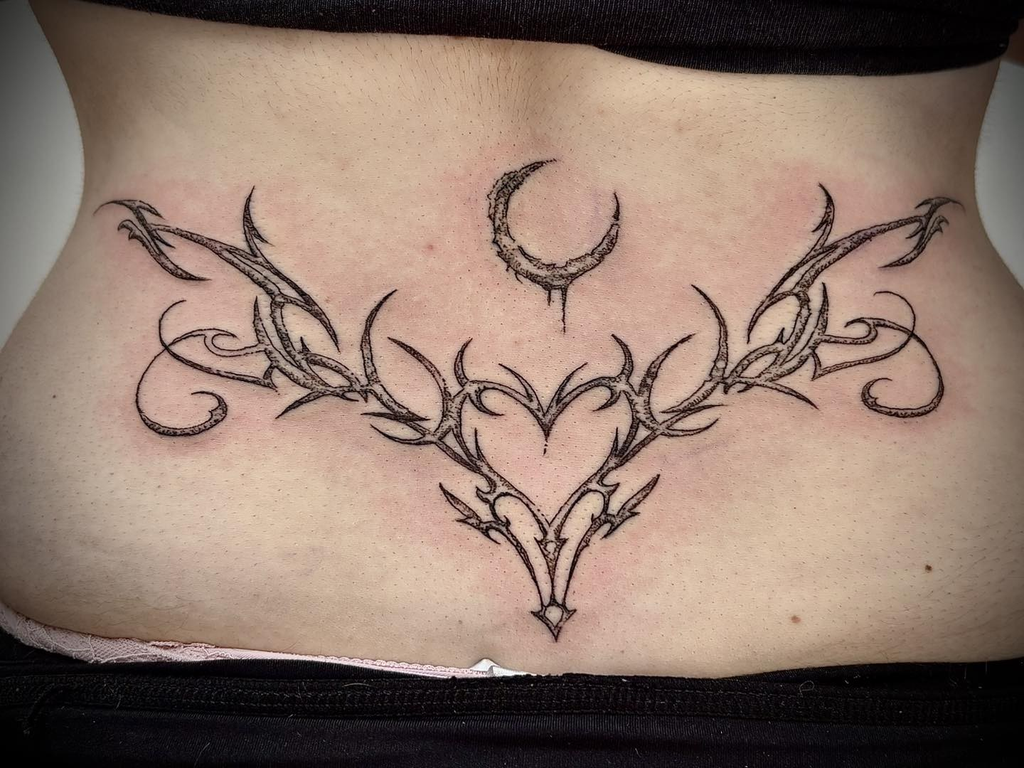
Above the primary structure sits a separate crescent moon rendered with textured black shading, establishing a strong vertical focal point. Fine black linework dominates rather than solid filling, leaving substantial negative space between individual elements. The wide horizontal proportions complement the lower-back placement while emphasizing symmetry, elegance, and controlled visual balance.
Image 4
This upper-arm tattoo combines fine-line architectural imagery with subtle cybersigilism influences. The primary subject resembles an abandoned ornamental staircase rising beneath a curved archway, surrounded by creeping vegetation and delicate structural details. Extremely thin black lines define the steps, columns, decorative borders, and hanging organic growth, while fragmented vertical strokes extend beyond the architecture like digital glitches or incomplete construction lines.

Tiny star-shaped accents and sparse botanical branches contribute to the ethereal atmosphere. Unlike more aggressive cybersigilism designs, this piece relies on restraint, negative space, and fragile linework. The result feels like a surreal ruin dissolving into abstract technological marks, blending fantasy architecture with contemporary experimental tattoo aesthetics.
Image 5
This tattoo transforms cybersigilism into an intensely colorful composition extending from the forearm across the back of the hand and onto the fingers. Fiery orange, red, yellow, magenta, and dark purple forms overlap in sweeping, elongated shapes that resemble flames, liquid metal, alien anatomy, or distorted digital graphics. Darker sections create structural depth while brighter colors trace energetic pathways through the composition.
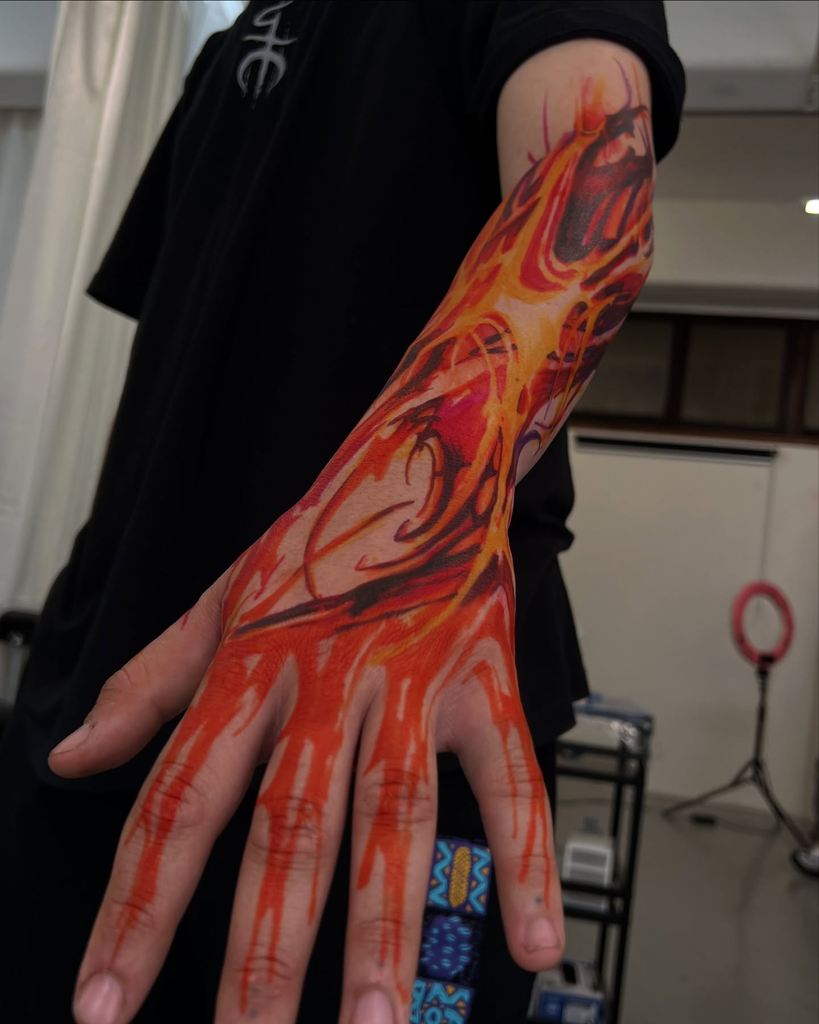
Numerous sharp projections, curved openings, and tapered streaks preserve the spiked vocabulary associated with cybersigilism despite the unconventional palette. The tattoo follows the anatomy closely, narrowing and expanding around joints and tendons. Long colored trails extending onto the fingers make the entire piece appear fluid, kinetic, and continuously moving.
Image 6
This cybersigilism tattoo uses extremely fine black and red linework to create an elongated abstract structure along the side of the leg. The black framework consists of narrow spikes, serrated edges, intersecting strokes, skeletal curves, and fragmented geometric components that loosely connect into a vertical formation.

Thin red marks weave around and through the darker structure, creating a secondary layer that resembles scratches, energy traces, or technical annotations. Large areas of untouched skin separate individual components, giving the composition a lightweight, almost diagrammatic appearance. Rather than relying on heavy blackwork, the design emphasizes precision and fragmentation. Its narrow proportions complement the leg while producing a futuristic, delicate, and slightly chaotic visual rhythm.
Image 7
This hand tattoo demonstrates a restrained form of cybersigilism built almost entirely from thin black lines. A long, flowing structure begins near the wrist, bends through the center of the hand, and continues toward one finger, allowing the design to follow the hand’s natural anatomy. At its center, several narrow intersecting strokes create an abstract sigil-like formation with pointed hooks, delicate spikes, and skeletal branching details.
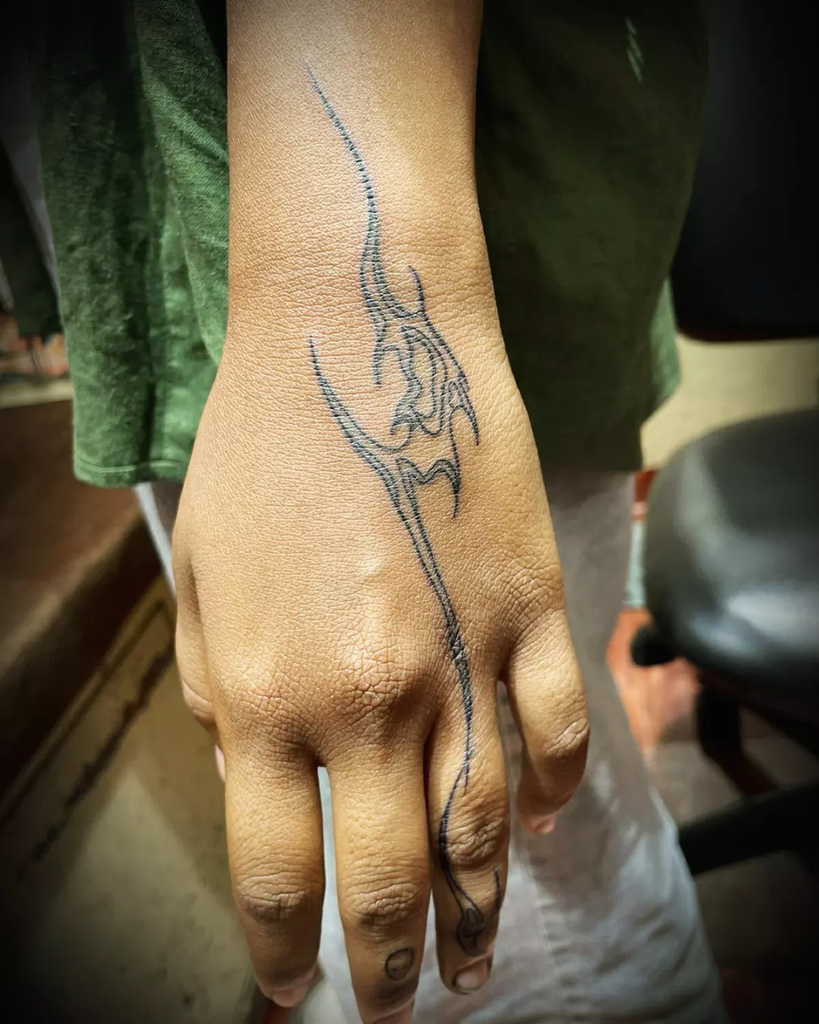
The surrounding lines stretch outward into elegant tapered curves, producing a sense of speed and directional movement. Minimal shading keeps the tattoo exceptionally light and open. Its sparse construction combines cybersigilism’s sharp, futuristic vocabulary with calligraphic fluidity, making the design subtle yet visually distinctive.
Image 8
This shoulder tattoo features a bold black cybersigilism composition built from interconnected flame-like, thorned, and blade-shaped forms. Unlike finer examples of the style, the design relies heavily on solid black filling, creating dramatic contrast against the exposed skin. Large curved openings function as negative space, separating the dense shapes and preventing the composition from becoming a single dark mass.
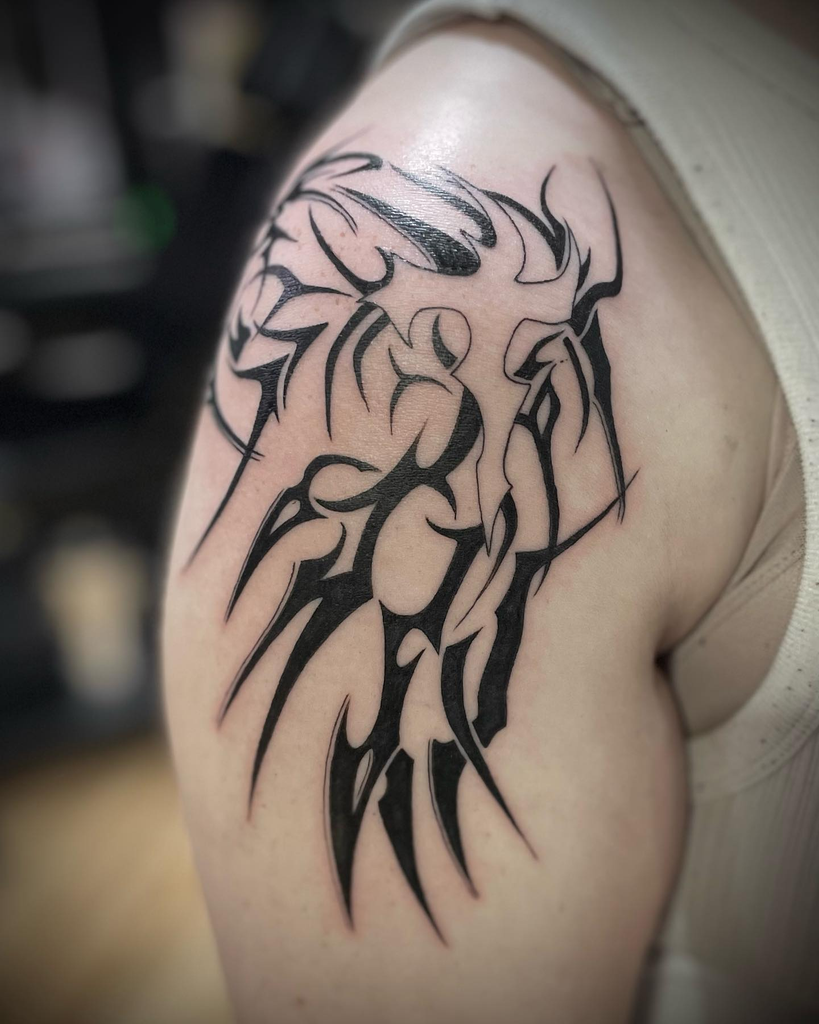
Numerous tapered points project outward and downward, giving the tattoo an aggressive, almost armored silhouette. The interconnected forms suggest an abstract creature, mask, crest, or organic exoskeleton without becoming completely representational. Its placement follows the rounded shoulder effectively, with sweeping upper curves and elongated lower spikes emphasizing the body’s natural contours.
Image 9
This forearm tattoo presents cybersigilism in a highly intricate, distressed form, creating an abstract structure that resembles a thorn-covered mechanical organism. The composition curves through the center of the arm, beginning with a dense circular cluster before extending into narrow branching sections. Fine black strokes overlap repeatedly, producing a tangled texture of spikes, hooks, scratches, and skeletal fragments.
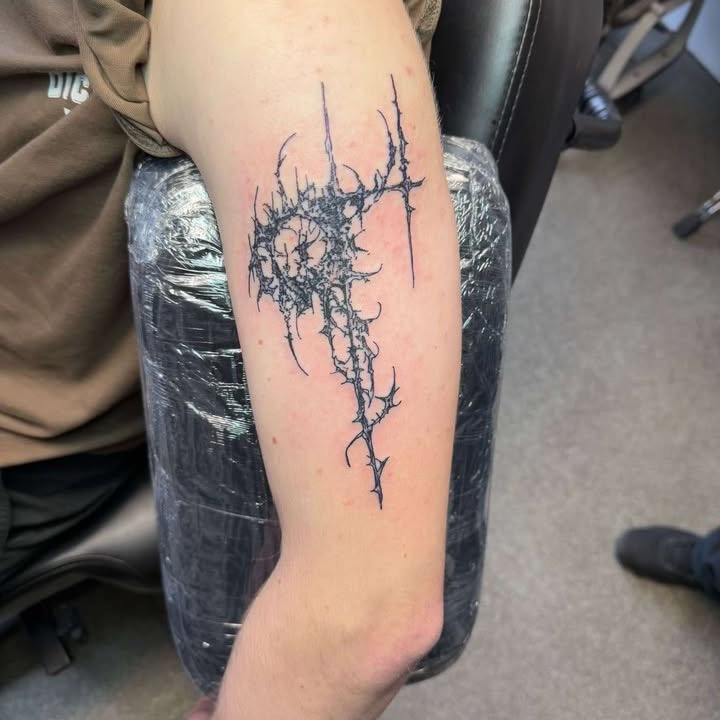
Several extremely long lines project outward from the central mass, increasing the design’s sense of instability and movement. Despite its complexity, substantial negative space remains around the tattoo. The result combines organic decay, digital distortion, and aggressive cybernetic imagery within a compact asymmetric composition.
Image 10
This forearm tattoo uses extremely precise fine-line work to construct a symmetrical cybersigilism emblem. The design resembles an abstract weapon, insect, or futuristic crest assembled from long curved blades and smaller ornamental components. Four prominent sweeping extensions establish the overall silhouette, while the center contains interlocking hooks, crescents, spikes, and narrow geometric structures.
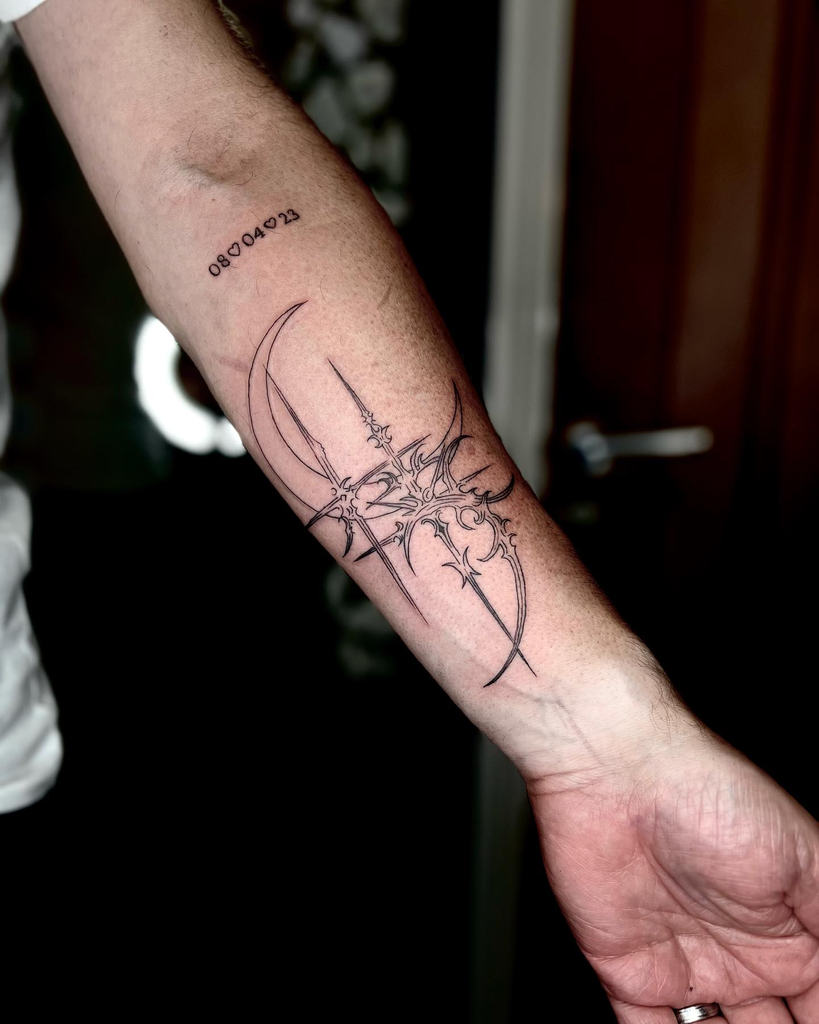
Almost no solid black shading is used, allowing the exposed skin to become an important part of the composition. The exceptionally thin outlines give the tattoo a clean technical quality despite its aggressive shape. Its balanced construction blends cybersigilism with gothic ornamentation, biomechanical imagery, and contemporary interpretations of tribal tattoo aesthetics.
Image 11
This image shows matching or closely related cybersigilism tattoos placed across the side torso and forearm. Both compositions use extremely detailed fine-line structures that resemble waves, wings, claws, or fragments of alien anatomy. Numerous layered curves flow in one direction before terminating in long hooked points, creating strong visual movement. Inside the larger silhouette, smaller organic compartments, rippling contours, and irregular cellular shapes produce a highly textured appearance without requiring heavy shading.
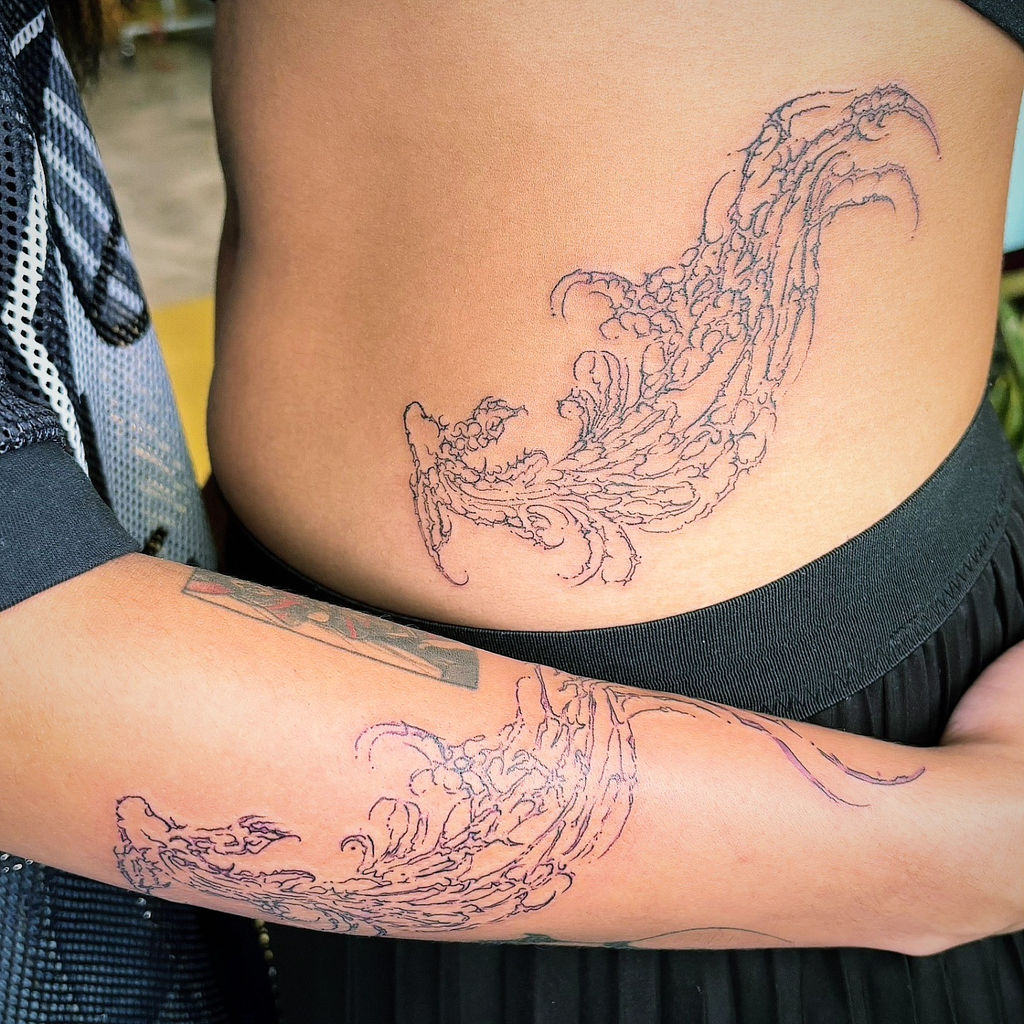
The designs remain predominantly linear, allowing skin to show through their intricate interiors. Their combination of flowing movement and skeletal complexity gives them an unusual biological quality, somewhere between marine organisms, cybernetic structures, and ornamental abstraction.
Image 12
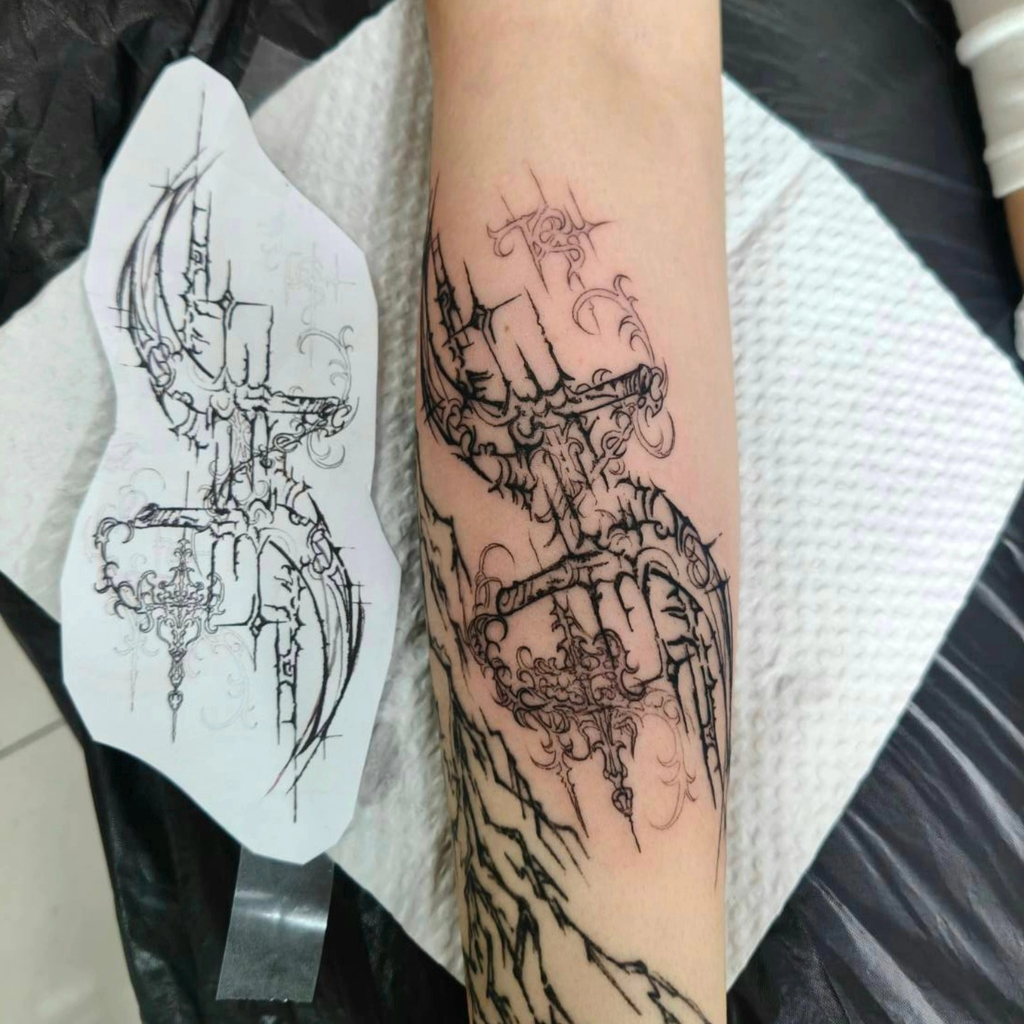
This forearm piece combines cybersigilism with gothic architectural and weapon-like imagery, producing one of the more illustrative designs in the collection. Two large curved structures dominate the composition, resembling mechanical scythes or elaborate skeletal blades. Their handles and surrounding framework contain ornamental scrolls, sharp projections, fragmented lines, and intricate decorative components.
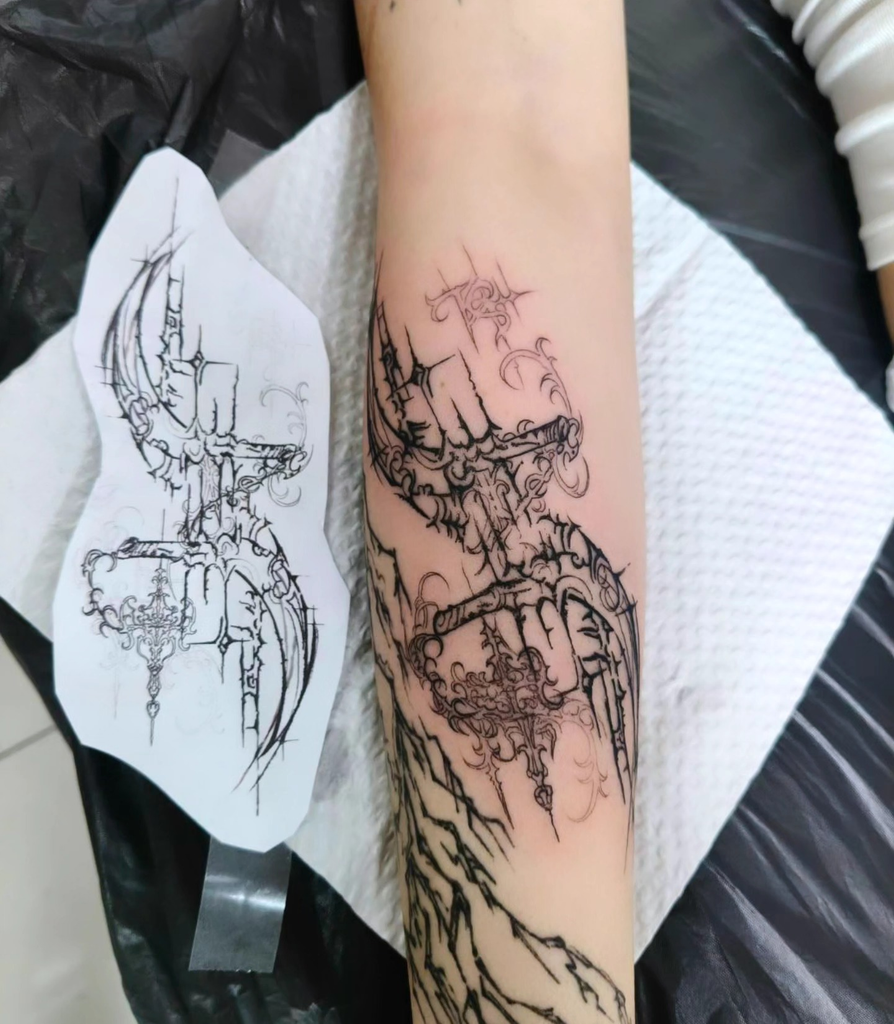
A highly detailed cross-like motif occupies the lower central section, introducing a strong gothic influence. Fine lines are layered beside heavier outlines to establish depth without extensive solid shading. The overall composition feels deliberately chaotic yet technically controlled, merging medieval ornament, biomechanical machinery, digital fragmentation, and cybersigilism into an elaborate futuristic weapon-like visual system.
Image 13
This chest tattoo forms a long horizontal cybersigilism structure that follows the natural line beneath the collarbone. The composition consists of several interconnected organic segments, each containing tiny cavities, curled details, skeletal ridges, and thorn-like projections. Long curved spikes extend upward and downward from the central framework, creating an appearance reminiscent of an alien spine, barbed wire, or biomechanical skeletal structure.
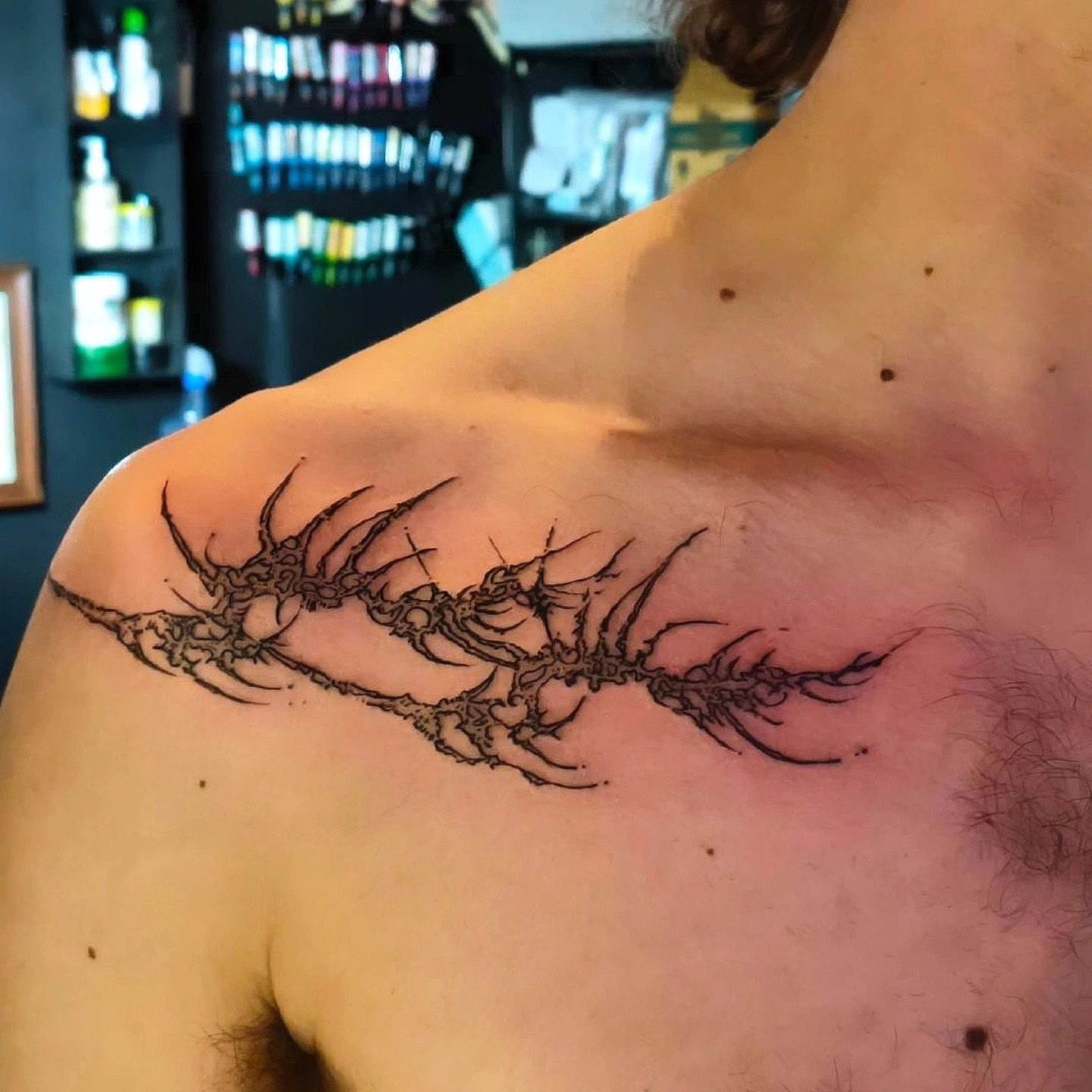
The linework remains relatively fine, with selective darker areas providing additional definition. Rather than relying on perfect symmetry, the tattoo uses repetition and directional flow to establish cohesion. Its elongated placement emphasizes the width of the chest while giving the design an aggressive yet highly ornamental presence.
Image 14
This fine-line cybersigilism tattoo creates an abstract, almost winged formation using delicate black outlines and extensive negative space. The central structure contains numerous curling shapes, irregular openings, pointed extensions, and organic compartments that resemble a fusion of skeletal anatomy and decorative metalwork. Several long spikes project from the upper and side sections, while dotted chains introduce a softer ornamental detail rarely associated with heavier cybersigilism. Small isolated star-like marks further fragment the composition.

The design appears intentionally incomplete in certain areas, allowing individual lines to dissolve into the surrounding skin. This restrained execution gives the tattoo an ethereal, futuristic quality while maintaining cybersigilism’s characteristic combination of sharpness and organic complexity.
Image 15
This large back tattoo expands cybersigilism into a highly symmetrical, vertically oriented composition resembling an alien exoskeleton, skeletal wings, or elaborate biomechanical crest. Two mirrored upper structures rise toward the shoulder blades before curving inward, while additional claw-like extensions spread outward through the middle and lower sections.
The interiors are filled with hundreds of irregular cellular shapes, ridges, cavities, and organic contours, producing remarkable visual density despite the absence of heavy black filling. A narrow strip of negative space runs through the central axis, strengthening the symmetry. Its monumental scale transforms the wearer’s back into part of the structure, creating an imposing fusion of biological anatomy and futuristic ornament.
Image 16
This elongated forearm tattoo takes a lighter, more streamlined approach to cybersigilism. Thin black lines form a vertically stretched structure that resembles a skeletal blade, alien bone, or abstract biomechanical limb. Long parallel curves establish the outer silhouette, while the central area contains irregular cavities, hooks, narrow channels, and ribbed details.

Several sections appear deliberately disconnected or only partially outlined, producing an unfinished, digitally fragmented effect. The tattoo becomes progressively narrower toward both ends, allowing it to follow the anatomy of the arm naturally. Minimal shading keeps the composition airy and technical, emphasizing line quality, negative space, and the tension between organic structures and mechanical visual language.
Image 17
This tattoo occupies the inner elbow area with a compact, highly detailed cybersigilism formation. Its central structure resembles an insect, crustacean, or microscopic organism reconstructed through abstract biomechanical linework. Numerous tiny interlocking shapes create a textured core, while longer spikes and curved appendages extend outward in multiple directions.

The placement allows these projections to radiate naturally around the elbow crease, making the anatomy part of the composition. Fine black outlines dominate throughout, with little solid shading and substantial exposed skin between elements. The irregular silhouette gives the piece an unstable, living quality, combining cybersigilism’s futuristic visual language with forms suggestive of arthropod anatomy, skeletal fragments, and technological circuitry.
Tattoo Aftercare Tips
Cybersigilism tattoos often depend on sharp points, precise lines, and strong contrast:
- Wash the tattoo gently with mild, fragrance-free soap.
- Apply a thin layer of moisturizer according to your tattoo artist’s instructions.
- Avoid scratching or picking at peeling skin.
- Minimize friction from tight clothing while the tattoo heals.
- Avoid swimming and prolonged soaking during the healing period.
- Protect the tattoo from direct sunlight while healing.
- Once healed, use sunscreen to help minimize fading.
Proper aftercare helps preserve the crisp linework and intricate shapes that define the cybersigilism aesthetic.
Conclusion
Cybersigilism tattoo designs offer a distinctive combination of futuristic imagery, abstract symbolism, and sharp ornamental linework. Whether you choose a small sigil-like symbol or an elaborate design stretching across the spine, chest, or limbs, the style provides plenty of opportunities for customization. An original composition designed around the contours of your body can make a cybersigilism tattoo feel especially dynamic, personal, and visually striking.
Frequently Asked Questions (FAQ)
Q1: What is a cybersigilism tattoo?
Cybersigilism is a contemporary tattoo aesthetic characterized by sharp, abstract linework, spiked or flowing forms, and imagery influenced by digital, futuristic, sigil-like, and tribal-style visuals.
Q2: What do cybersigilism tattoos symbolize?
There is no single universal meaning. Some designs are created primarily for their aesthetic, while others incorporate personal symbolism, identity, transformation, technology, or individually defined meanings.
Q3: Where do cybersigilism tattoos look best?
Popular placements include the spine, sternum, lower back, shoulder, forearm, hand, thigh, calf, and upper arm.
Q4: Are cybersigilism tattoos usually black?
Black ink is particularly common because it highlights the style’s sharp shapes and high contrast, although other interpretations are possible.
Q5: Can cybersigilism tattoos be small?
Yes. Small sigil-like designs can work well, but extremely intricate details may need additional size and spacing to remain readable as the tattoo ages.
